Capture the case.
Log a case, create an operative-report draft, or paste a note you already wrote.
UNIRA connects case logging, operative documentation, billing review, analytics, and surgical reference around one record you control. Each case adds context, helping you uncover patterns, understand your progress, and make clearer decisions throughout your surgical career.
Academic or private. Employed or independent. Early-career or established. Every operation creates useful context across documentation, billing, productivity, outcomes, and the questions you ask.
UNIRA connects those signals around the one constant:
your practice. The work you do today can create a clearer view of what comes next.
In UNIRA, each case becomes context for a clearer view of your work, your progress, and your practice.
Log a case, create an operative-report draft, or paste a note you already wrote.
Organize the procedure, complexity, documentation, coding information, timing, and outcomes you choose to track.
Build a view of your case mix, volume, productivity, documentation style, and practice patterns.
Bring it into billing review, documentation, analytics, and surgical-reference questions.
As your record grows, the context available to every UNIRA workflow grows with it. The immediate return is a better workflow around today’s case. The long-term return is a practice record that keeps becoming more useful.
Generate the note from a few words, or paste the note you already wrote. UNIRA turns either workflow into a detailed, reviewable account that connects clinical work, documentation, and coding review.
Say or type what was unique about the operation. OpWriter builds a case-specific operative-report draft from the details you provide and, when available, examples of how you write. You review, edit, and finalize the record.
See how OpWriter worksUNIRA can surface candidate procedure and diagnosis codes, modifier considerations, and documentation details worth strengthening, linked back to the language in the note for surgeon and billing-team review.
Explore the billing layerCandidate codesProcedure and diagnosis options tied to documented language.
Modifier considerationsPossible modifiers and edit relationships to examine.
Documentation opportunitiesSpecificity and support worth strengthening before sign-off.
Questions brought forwardReview points stay visible and connected to the operative record.
Built for informed review. UNIRA gives the surgeon and billing team a clearer surface for review while final coding and claim submission remain in their established workflow.
One connected set of workflows makes the work you already do more useful today and more revealing over time.
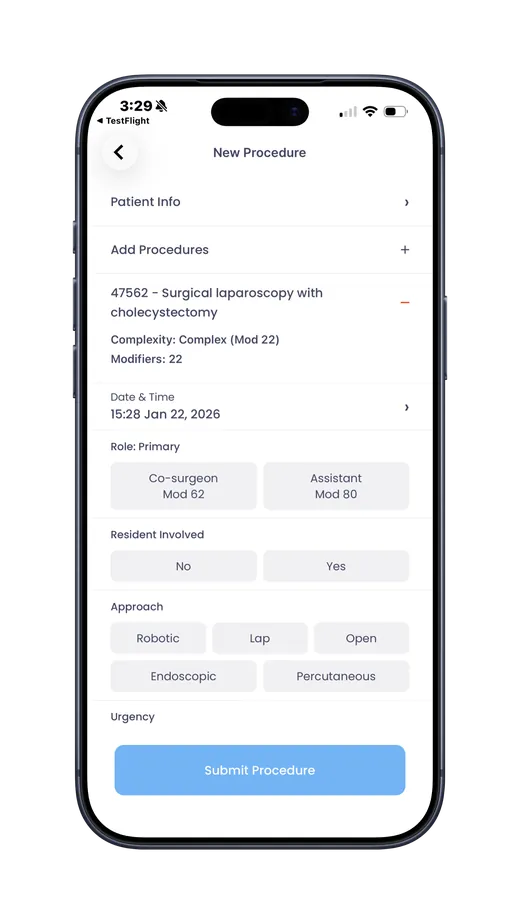
Import historical cases, maintain one continuous log, and export the record for credentialing, recertification, contract discussions, or a move between practices.
UNIRA can use the cases, notes, and preferences you choose to share to shape responses around your specialty, your history, and how you actually work.
Every relevant detail helps the platform create a clearer and more useful answer.
Answers point back to your case history and underlying numbers.
“Which procedures account for most of my wRVUs this quarter?”
Review points connect back to the operative note and applicable coding guidance.
“What documentation should I review before using this modifier?”
Clinical-reference answers are designed to include sources and preserve surgeon judgment.
“Review the key steps and evidence for this approach.”
Build a professional record designed to remain useful across jobs and career stages. You decide what becomes part of UNIRA, which workflows use it, and when to review, export, or delete your data.
You decide what you add and which workflows use it.
Insights point back to the record or source supporting them.
Your case history is designed to move with your career.
UNIRA complements your clinical and billing systems with surgeon-controlled practice intelligence for documentation, review, analytics, and career-long learning.
“As a high-volume thoracic surgeon, time is everything, and UNIRA respects that. I use it to track my RVUs, case types, and operative-time trends without the usual hassle. It gives me a clear view of my productivity and helps me stay on top of billing without digging through reports.”

“As someone who has spent over three decades training surgeons, I see UNIRA as a breakthrough. It gives young surgeons the tools I wish we had years ago, objective data on their case volume, complexity, and progression over time.”

“Before UNIRA, tracking my cases was a chore. Now I can see trends in my operative times and RVUs without digging through spreadsheets or relying on hospital reports. The record is finally useful to me.”

“Every case in a surgeon's career can teach us something. When those cases become one continuous record, we can see how our practice is evolving, understand the value of our work, and carry that knowledge into every decision that comes next. I built UNIRA to make that possible.”

Begin free, then unlock the full platform when you are ready to connect documentation, billing review, analytics, and reference.
Start building the record.
The connected platform.
AI-generated operative-report drafts, coding suggestions, and clinical-reference content require professional review.
UNIRA is designed to grow around the surgeon's workflow and make each connected feature more useful over time.
UNIRA can use the cases, operative notes, writing examples, questions, and preferences you choose to add as context. That can make documentation, analytics, billing review, and reference responses more relevant to your specialty and the work you actually do.
Yes. Case logging, operative documentation, billing review, analytics, and surgical reference address work shared across surgical specialties. Procedure-specific outputs remain decision support and require surgeon or coding-team review.
Yes. You can paste or upload an existing operative note for review. UNIRA can surface candidate codes, modifier considerations, and documentation details worth strengthening, tied back to the note.
UNIRA supports documentation and coding review by connecting candidate codes, modifier considerations, and review points to the operative record. Final coding, claim submission, and payer-specific decisions remain with the surgeon, certified coder, and practice billing workflow.
Each case adds context for documentation, billing review, analytics, and reference. A more continuous case record gives the platform a more complete longitudinal view of your practice.
You retain ownership of the content you add to UNIRA. You can export your data and delete your account under the platform’s published terms and privacy controls.
UNIRA complements the EMR, institutional protocols, certified coding review, and clinical judgment with surgeon-controlled practice intelligence and decision support.

Build a record that connects today's operative note, this month's numbers, and the next question you ask.